
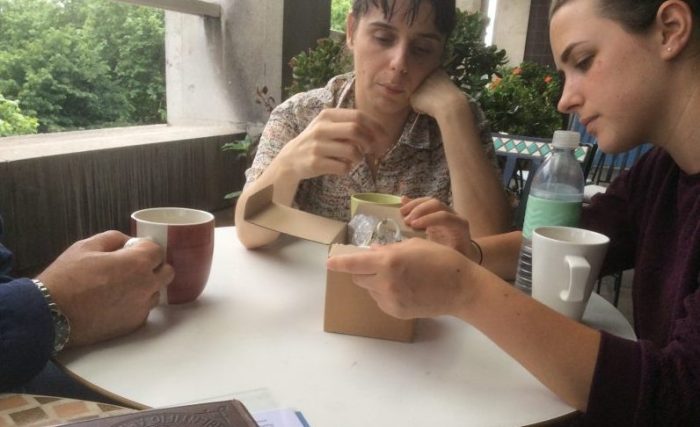

Experts from the conservation course ponder my grandmother’s teacup mend.
My grandmother would have been amused that an unremarkable event had such a profound effect on me.
I was a child, spending long holidays, as always, with my Manx relatives. We were in the scullery of her stone cottage in the Isle of Man. It was a tiny space- dark but with a deep windowsill where milk would be kept cool by standing the bottle in a bowl of cold water.
As she scoured a saucepan with Ajax powder, her pressure suddenly caused a tiny hole to appear in the bottom of the pan. Nana peered at it.
‘Such a shame, she pondered ‘The pans were a wedding present. I can’t get it fixed now – I haven’t seen a tinker pass by in years’.
The timespan of her recollection seemed like an eon to me. She must have been married about sixty years and to my young mind, tinkers were merged with fairies and wood sprites. It was hard to imagine they had ever been real people.
I mentioned this memory to Dr Dean Sully when we were talking about the demise of repair.
‘So did the repairing stop because the tinkers didn’t come or did the tinkers stop coming because the repairs did not come?’
I have just been shown around the Msc conservation lab in the Archeology department of University College London. White coated students sit at lamp lit desks brushing specks of dust from broken boxes. A finely woven 19th century basket from Indonesia has finally succumbed to gravity and collapsed. A fragile boat made entirely from cloves waits for its treatment. What it is suffering from is age and light, but what support it will get will be determined by Dean and his team of meticulous students. There are disassembled objects made from shell, bamboo, lacquer, leather and iron that are all waiting for creative solutions to hold back time.
Conservation of such a variety of materials requires a wide knowledge of techniques that are about as far away from the tinker’s trade that I can imagine, but that’s partly why I am visiting.
I have brought a tea cup with a handle that is fixed with metal tape and what I think is milk. This belonged to my grandmother and now it’s mine. Edmund De Waal inherited an ivory Hare with Amber eyes – I get a cup with a broken handle.
I help repair everyday items at our repair events. I leave the electrical devices to those that know better, while I ponder the broken analoque objects that endear their owners to bring them along.
Along the way, I have collected old recipes for mixtures that sticks stuff to stuff. That’s glue to use its modern parlance, but more accurately cement. No, not what’s meant by cement these days – that’s mason’s cement to the 19th century writers. ‘Glue’ is made from horses. Or fish. Or rabbits. As some people read cook books, I read workshop recipe books. ‘Receipts’ as they were called.
Under ‘Milk’ the 1885 writer chides ‘This cement is not so generally known as it ought to be’….’ it is the simplest and best domestic cement for repairing china and crockery. The process consists simply in tying the parts firmly together and boiling them in skimmed milk.
That’s why I suspect my cup is mended with milk.
Unlike the conservationist, everyday breakages used to be fixed with dollops of tin solder, black tar and the scourge of the restorer – a nail.
The recipes for more complicated fixings include a flurry of white lead and a dash of arsenic and hopefully I can recreate these in a safe environment one day. Dr Sully and his students are colluding with me to find a lab to invite would-be fixers to step back in time and test bygone methods of making do and getting by.
We have got lazy with our attitude to fixing. Instead to seeing the time as enjoyable and well spent, we regard the process as frustrating, time consuming and a waste. When we do invest in the time to tinker over a broken thing, most people find it fulfilling and incredibly satisfying .
Meanwhile, I am happy with my large collection of diverse modern day adhesives. Perfected in labs, and readily available, we use water based glues like PVA a lot to fix furniture and most things wood. But I know when to put more trust in a two-part epoxy or that wonder of the modern age – Super glue.
I could have soldered my grandmother’s pans with what I know now, but I prefer to use my modern, copper based saucepan that won’t be needing a tinker anytime soon.