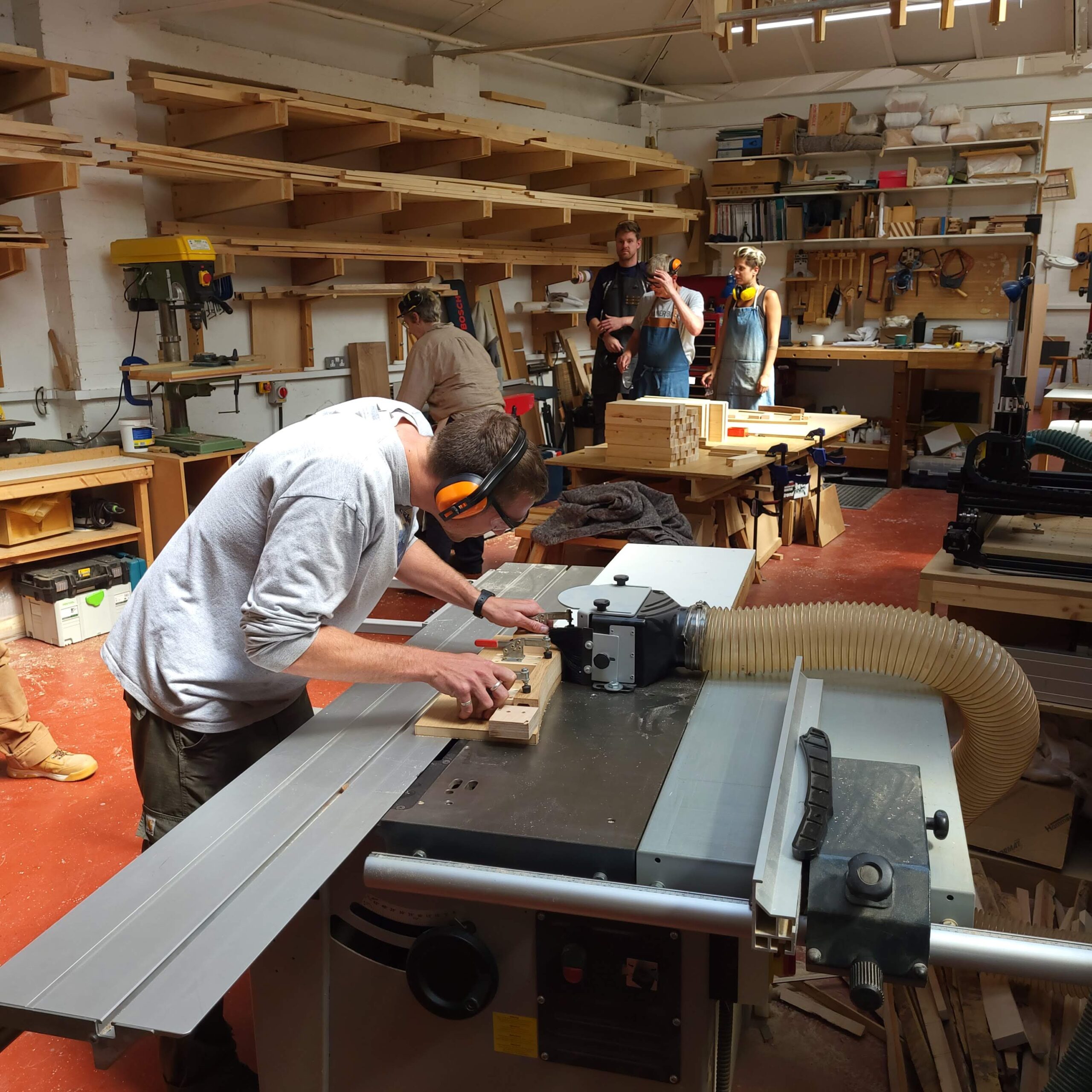
Course: Introduction to Furniture Making
Duration: Every Wednesday and Thursday / 38 weeks 10am-4:30pm, School term times.
Cost: £10,900 (includes VAT). Installments available.
Next start date: 15th April / 16th September 2026
Suitable for: Suitable for beginners, as well as those who wish to gain more experience.
About: From timber yard to final finish. Learn the entire process of a furniture-making project. This woodworking course is ideal for those looking for part-time high quality learning in furniture design and making.

Introduction to Furniture Making is a part-time workshop based course spread over 38 weeks created to bring the beginner to a level of confidence in furniture design, using hand tools and workshop machinery. It provides development of classic, traditional architectural joinery skills and use of our industry standard woodwork machines.
This special course is open to 4 learners, so a tutor will always be available to you. We supply all of the tools you will need – though we advise you to start building a lifelong collection of your own pieces as you go along.
The Goodlife Centre has been teaching practical woodworking since the centre opened in 2010. We teach traditional skills using hand tools in the same manner that has been handed down for hundreds of years.
You will follow the design process through the use of rods, technical drawing and the use of hand and power tools.
The subjects covered range from timber preparation to completion of several projects within a specific size. (Purchase of hard wood not included)
You will learn:
- how to use hand tools skilfully and how to sharpen tools
- high standard joinery skills, including cross halvings, dovetails, mortice and tenons, bridle, corner halvings
- how to safely use industry standard portable power tools including a router.
- how to set up and use woodworking machines (Band saw/Table saw/ planer thicknesser/ Crosscut saw/Mortiser in accord with the latest Health and Safety legislation.
- how to construct projects such as a basic frame, hardwood dovetail bookends, a decorated tray, and a hardwood cabinet of your own design.
The course is paced to help you learn your natural speed of working. The initial part of the course cannot be rushed through. There is no easy path to becoming a good maker and taking the initial projects carefully will give you the underlying skills to clarify your thinking when it comes to later pieces.
The set projects will take you through simple planing and jointing exercises to some basic machine skills. You will be inducted into the machining area so you can be trusted to use the equipment safely and independently. As you move from project to project you will gain more confidence and independence.
Understanding Material
Hand skills are fundamental to the production of fine furniture. It is only through gaining an understanding of the material you work with be it oak, elm beech or ash that you can become a good maker and then potentially a good designer of furniture.
So the route to good furniture design in timber is through understanding the material and how it is worked and the best way to do that is to interact by cutting, sawing, planing and chiselling until you know how the material can be worked. Each time you touch the material with your hands or with your tools there is something to be learnt about what you can and can’t do, how a particular species will polish up and finish, or how another might keep a crisp edge or crumble.
Hand Tools
We supply you with the use of our hand tools but we encourage you to aquire your own tools to last a lifetime. These will be: Hand planes, saws, chisels, marking and measuring tools.
These form the building blocks of woodwork. You will spend some more time at the start of the course testing out and fettling your tools which will need some preparation whether old or brand new to bring them up to workshop standard. Sharpening is a key skill that needs to be practised until you are confident. Time spent honing your tools now is well spent as they will be well set up whenever you need them.
Reading List
We have rather a large library of reference books on the subject of furniture and woodwork. Students are encouraged to read around the subject as much as possible.
Selected recommended titles include:
- James Krenov – Impractical Cabinetmaker
- The Fine Art of Cabinetmaking
- George Nakashima – The Soul of a Tree
- Betty Norbury – Bespoke
- Sam Maloof – Woodworker
- Tage Frid – Tage Frid Teaches Woodworking 1,2,3
- Ernest Joyce – The Technique of Cabinetmaking
The use of all tools, machinery and materials is included – except the purchase of hardwood for the final project.
Participants of this course are able to access to other related courses at the centre at a discounted rate.
Course fees: £10,900 (£9083 + VAT)
This includes all use of hand tools and machinery. Excludes purchase of hardwood for the final project.
Payment options:
1. Payment in full before the beginning of the course.
2. Payment in instalments (incurs 3% admin fee): Initial deposit of £2500 due by 16th September. Followed by 7 instalments of £1236 due on 16th October, November, December, January, Febuary, March, April
Our class sizes are small. Maximum 4 per course. We encourage you to secure your place as soon as possible.
Call us for more info or arrange a visit and tour of the centre.
Ruth Thomson
- City & Guilds Diploma in Carpentry and Joinery
- Advanced City and Guilds Diploma in Furniture Making
- DTLLS (Diploma Teaching Lifelong Learning Sector)
- Joiner and carpenter since 1986
- Teaching diploma course since 2010
Ruth Thomson was recently asked about the process of a chopping board she was making. She described it as this;
- 75-100 years to grow and then it fell and lay in the woods for a while
- 1 day to pull the fallen tree out of the wood, either by tractor or horse
- 1 or 2 days to cut it into planks and store it
- 3 years of drying in the barn
- 1 day to cut, shape and oil it
Ruth is always interested in all things timber. Holding any piece of wood is cause for wonder. It is unique. It may be a lot like the other planks in the pile, but it’s not. It may have characteristic knots that won’t appear in the same place ever again. The grain of the wood marks the history of its growth and sometimes shows the direction that the wind hits the tree. Different species hold qualities that others don’t. Wood tells its story if you know how to read it.
All this delicate finesse and wistful thoughtfulness belies Ruth’s professional background. When we moved to our current building in 2015, Ruth headed the conversion. The Goodlife Centre took over a 1956 cardboard box factory with a huge 2000 square foot ground space.
Ruth also teaches our 24-Week Woodwork Course at the centre.
General Information
You will receive a courtesy reminder by email 1-2 days before the workshop/course begins.
Refreshments
Coffee, tea and biscuits are included in the course fee, but you will need to bring lunch with you or visit a nearby venue to purchase food.
Access
If you have any specific access or special needs, please contact us confidentially in advance by email info@thegoodlifecentre.co.uk. There is a small step to the entrance, and the toilet is on the ground floor.
All sewing workshops and occasionally lampshade making, tassel making and bookbinding workshops are located on the second floor. There is no lift access.
Refunds and cancellations
Please refer to our terms & conditions below.
Disclaimer
The information given is accurate at the time of publication. However, The Goodlife Centre reserves the right to cancel or amend courses if circumstances require.
Terms & Conditions